Arduino boards
- Arduino Diecimila
- Arduino Leonardo
- Arduino Mega
- Arduino Nano
- Arduino Micro pro
- Arduino UNO
- Arduino Duo and Arduino Yun
- Lilypad (Wearables)
- There are other boards, which work with the Arduino IDE like ESP8266, ESP32, FPGAS,.. ESPs and FPGAs are good alternatives to Arduino now integrating bluetooth, WIFI, LoRAWAN and even more in one device.
ARDUINO UNO The pin mapping
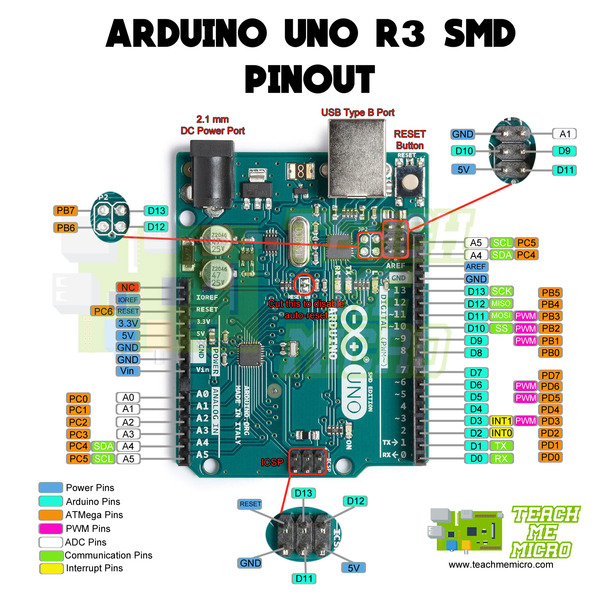
Attention: Every ESP32-Board has a different PINOUT-Diagram. You should know that some of them are used for internal functions as WIFI,SPI,I2C,.. That changes between the diffent boards.
Arduino Voltage
Boards generally have an onboard voltage regulator. Some of which can struggle above 150mA, especially for Nanos and Tinys. If you have a suitable supply, this can be bypassed.
5V is normally OUT, used for things like I2C device power, but you can hook this up to a lower voltage battery, batteries will not have ripple or RF noise, but they may droop. Bear in mind anything relying upon regulated 5V as a "reference" will scale to your battery voltage.
Vin may or may not be regulated, but should be above 5v for further regulation to 5V (nominally)
Vin should generally be < 12V, probably no higher than 15V, depending upon the regulator and the upstream capacitor limits. The odd LM7805 regulator can cope with 35V, but the capacitor maybe only 16V. The higher the voltage the less efficient the regulation will be.
Vcc is the DIP package supply, it should be 5V, whatever the source, but boards might range from 2.7V to 5.5V depending upon design and that datasheet.
You should be aware of "Brown Out Detection" and disable it, or set it below your battery vor a oltage. Your results will be arguably better with a "Branded" board.
For a 3.7v LiPo I would strongly recommend a 3.3V Nano type design, through the onboard regulator with a switch to prevent the battery from draining through the regulator when the board is quiescent.