IOT
What is IOT
Internet of Things
The Internet of Things (IoT) is a system of interrelated computing devices, mechanical and digital machines, objects, animals or people that are provided with unique identifiers (UIDs) and the ability to transfer data over a network without requiring human-to-human or human-to-computer interaction.
The definition of the Internet of Things has evolved due to the convergence of multiple technologies, real-time analytics, machine learning, commodity sensors, and embedded systems. Traditional fields of embedded systems, wireless sensor networks, control systems, automation (including home and building automation), and others all contribute to enabling the Internet of Things. In the consumer market, IoT technology is most synonymous with products pertaining to the concept of the "smart home", covering devices and appliances (such as lighting fixtures, thermostats, home security systems and cameras, and other home appliances) that support one or more common ecosystems, and can be controlled via devices associated with that ecosystem, such as smartphones and smart speakers.
What is IOT?
What is similiar
- M2M - Mashine to Mashine
- D2D - Device to Device
- Smart-Home
- Industry 4.0
Where to use IOT?
- Infrastructure
- Medicine
- Industry (energy)
- Smart Home, Smart City, Smart ...
- Hobbies
- Agriculture (Farm, Plants, Animal)
IOT is a system
What is a system?
What are the components of a system and especially of this system?
interrelated IOT components
**like
- interrelated computing devices
- mechanical and digital machines
- objects (pictures, messurements, manipulated variable
- animals
- people
provided with unique identifiers (UIDs)
UIDs
what could that be?
- for devices
- for mashines
- for animals
Special abilities
the ability to
- transfer data over a network without requiring human-to-human or human-to-computer interaction
- finding automatically solutions for best practices (KI?)
- decide how to act as a mashine in IOT-Systems (Decision making )
- give commands to other devices
- ask for information from other devices
The future of IOT (12.11.2019)
Internet of Things by 2025:
The internet of things devices such as machines and sensors are expected to generate 79.4 Zettabytes of data in 2025 which is predicted by IDC (International Data Corporation). Also, IOT will grow at a compound annual growth rate of 28.7% over 2020 t0 2025.
According to the projection of the statista Research Department, 75.44 billion devices will be connected with the IOT worldwide by 2025. IOT internet technology is the next major step in making the world a connected place.
The Internet of Things Grows Artificial Intelligence(12.11.2019)
We know IOT refers to the device that transfer data over a network that generate unimaginable amounts of data and many organization are clueless about how to manage this amount of data. Also, No organization will ignore this data if it is related to customers and their personal information.
Machine Learning is a type of AI (Artificial Intelligence) that helps computers to learn without programming them. The computers are programmed in a way to focuses on data they receive from the device and learn with the received data to understand the customer’s preference and adjust itself accordingly.
To solve this amount of customer data, IoT allows data flow between the device and AI can help to manage this data without any human errors. Also, AI is considered the key propellant to the growth of the IOT revolution.
Routers will become more Secure to block unwanted access (12.11.2019)
The IOT makes your home, city, cummunity smarter and more efficient when it secured from cybercriminals. Your home devices are connected with the internet like smart TV, security cameras, door locks and more can add a level of luxury and comfort in your life, but also they can make your home unsafe. Here the router will play an important role by securing the entry point of the internet into your home. While your smart IOT device cannot be protected, the router will protect the entry point of the internet by password production, firewalls, and configure them to allow the only certain device on your network.
Modern IoT-Frameworks(12.11.2019)
The era of the Internet of Things (IoT) has arrived, if somewhat fitfully. Lots of observers (including this blog) have sung the praises of IoT and how transformative it will be, with compelling benefits for both businesses and consumers.
Less is commonly known, however, about how incredibly difficult it is to get a working IoT system of any kind designed, built, tested, and deployed. Whether it’s a mass-produced consumer-grade system intended for people’s homes or highly customized systems for solving individual business problems, a number of fundamental decisions must be made, and with so many “moving parts” that must operate together as a cohesive system, an IoT project can quickly become an engineering nightmare.
The Complexity of IoT Systems
IoT system designers must contend with the following design decisions, among others.
1.Communication: IoT devices must naturally communicate, whether among themselves, with a central controller or server, with mobile devices, or some other arrangement. What communication technology will be used—wired or wireless? Full-stack TCP/IP or some other protocol? What data rates are needed? Will communications be continuous or intermittent?
- Processing: Will the computational heavy lifting occur on-board the device, on a user’s mobile device, on a local server, or in the cloud? How much latency is acceptable?
- Power: How much power will the devices need, and how will that power be delivered? Will batteries be involved? Replaceable or rechargeable? For rechargeable, how will they be recharged? Can the devices be powered only by a solar cell, or by some other, more exotic method of harvesting ambient energy?
- Updating: Will the devices need firmware or software updates? How will these updates be delivered and installed?
- Interoperability: Will the system or any of its components need to integrate with other systems? How will this be accomplished?
- Build or buy? Can the system be built with commercial off-the-shelf components or is some custom design and fabrication needed? How can that be done economically?
IoT-Framework-Situation
The IoT framework landscape is still somewhat fragmented. It probably will remain so until the various technologies mature and standards are developed for device and system interoperability. Here are some things to look for in the near future:
- Open-source frameworks. The key to interoperability will be open-source. Look for more support in the IoT development community for open-source solutions.
- Hardware agnostics. Currently there is a focus by IoT frameworks on a few selected hardware platforms. Frameworks will become more useful if they are hardware-agnostic, so look for the development of standards in this area.
- More deployment options. Many frameworks and platforms have a cloud-centric view of the world, which makes sense for many use cases, but it’s feasible that some specific business cases will not want to (or cannot, because of limited internet connectivity in some places) rely on the existence of a robust, high-speed, continuous cloud connection. Look for solutions that are equally at home in the cloud, on locally hosted servers, or even on PCs, laptops, and mobile devices.
IoT sensors of tomorrow(12.11.2019)
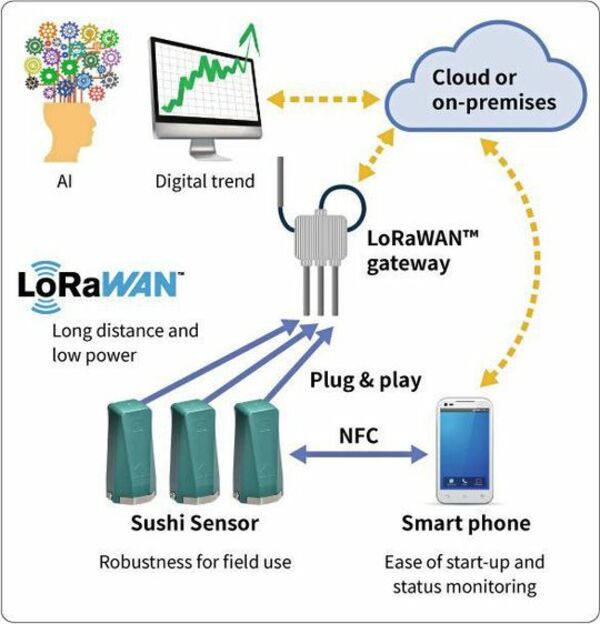
integrated LORA Sensors